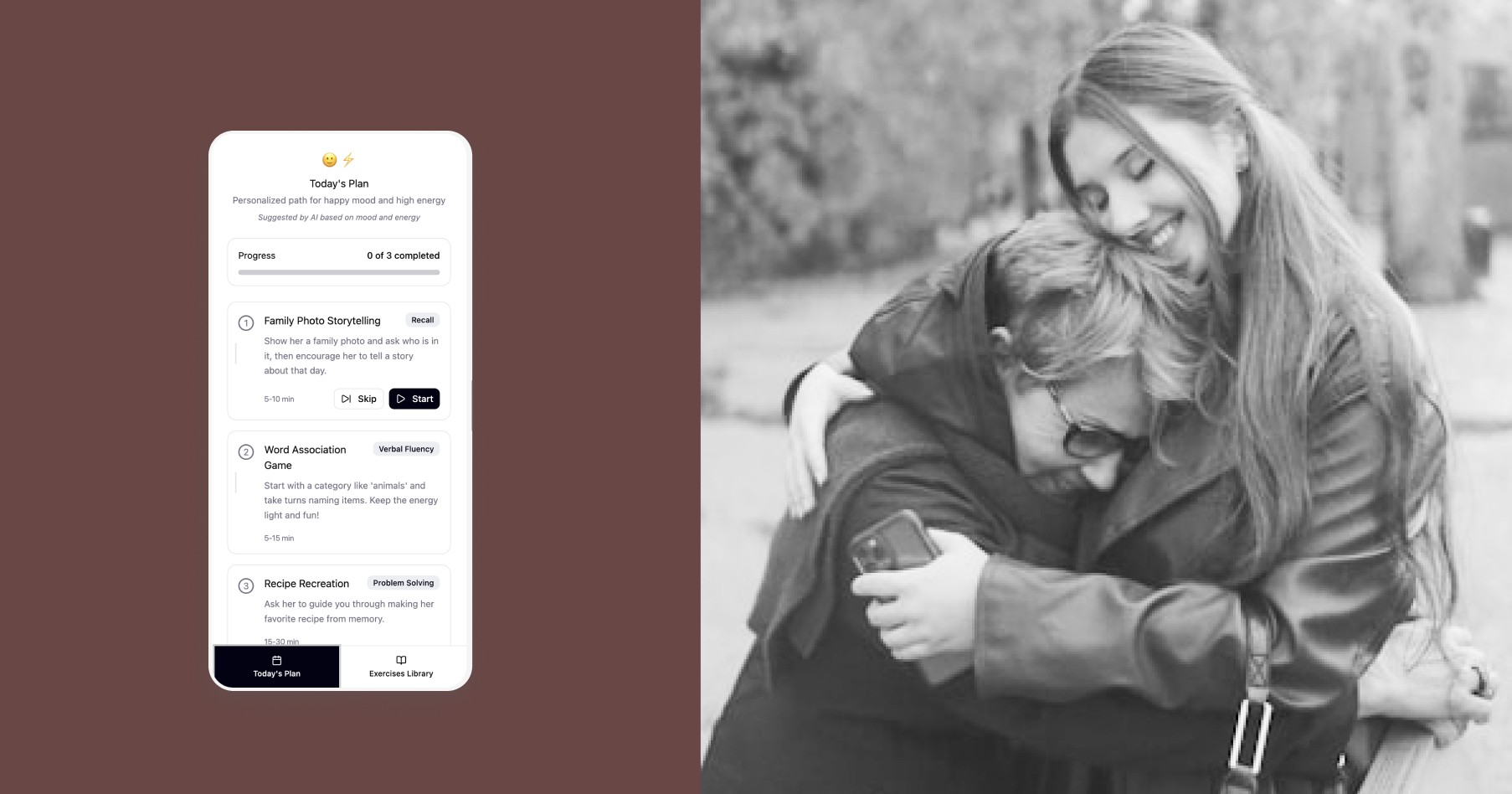
Memory decline is not an exception it's a shared human experience

My grandmother's memory has started to fade, small gaps here and there. I've noticed how our conversations sometimes turn into little memory games: "Do you remember what you had for breakfast yesterday?" "Who did you talk to on the phone this morning?"
These moments help her stay engaged, but it's not always easy to keep them fresh. I often repeat myself, unsure which questions actually help her recall or think deeper. Research shows that consistent, meaningful conversation helps sustain cognition, but knowing what to ask in the moment is harder than it sounds.
This post is an experiment in care thinking about how AI can support: how could a tool quietly support the conversations we already have — without gamification, streaks, or clinical vibes? I’m sharing the problem I’m designing for, a prototype interaction pattern, and what I’m learning from testing it in real life.
Maybe good AI for care should actually be boring
Most brain training apps I've found feel gamified, task driven, and clinical designed for solo use, not for the moments we actually share together. They optimize for engagement metrics, not for human connection.
The more I thought about it, the more I realized: Maybe good AI for care should actually be boring. No streaks. No leaderboards. No dopamine hits. Just small, quiet prompts that make daily conversations easier to start and easier to sustain.
How AI could quietly support those moments, instead of replacing them?
I decided to embark on a journey into an "unsexy" space: senior care. I'm using this project to learn in public to understand where AI can truly add value in design without taking away what makes care human. Roughly 1 in 6 adults over 60 experiences some degree of cognitive decline, which means nearly every family will face it sooner or later.
I'll be sharing my process, the research, what works, what doesn't, and what I learn along the way.
Approach
Academic grounding:
Consensus → peer-reviewed research on reminiscence therapy, cognitive stimulation, dementia care protocols
Perplexity → synthesis and framing
Human insight:
Reddit → real caregiver experiences, daily challenges, emotional context
Direct testing → sessions with my grandmother
Design research & inpiration:
IDEO aging research → principles for care-centered design
Competitor analysis → existing apps, gaps, opportunities